
The Southern African Development Community (SADC) has been in existence since 1980, when it was formed as a loose alliance of nine majority-ruled States in Southern Africa known as the Southern African Development Coordination Conference (SADCC), with the main aim of coordinating development projects to lessen economic dependence on the then apartheid South Africa.
The founding Member States are Angola, Botswana, Lesotho, Malawi, Mozambique, Swaziland, United Republic of Tanzania, Zambia and Zimbabwe.
SADCC was formed in Lusaka, Zambia on April 1, 1980, following the adoption of the Lusaka Declaration – Southern Africa: Towards Economic Liberation.
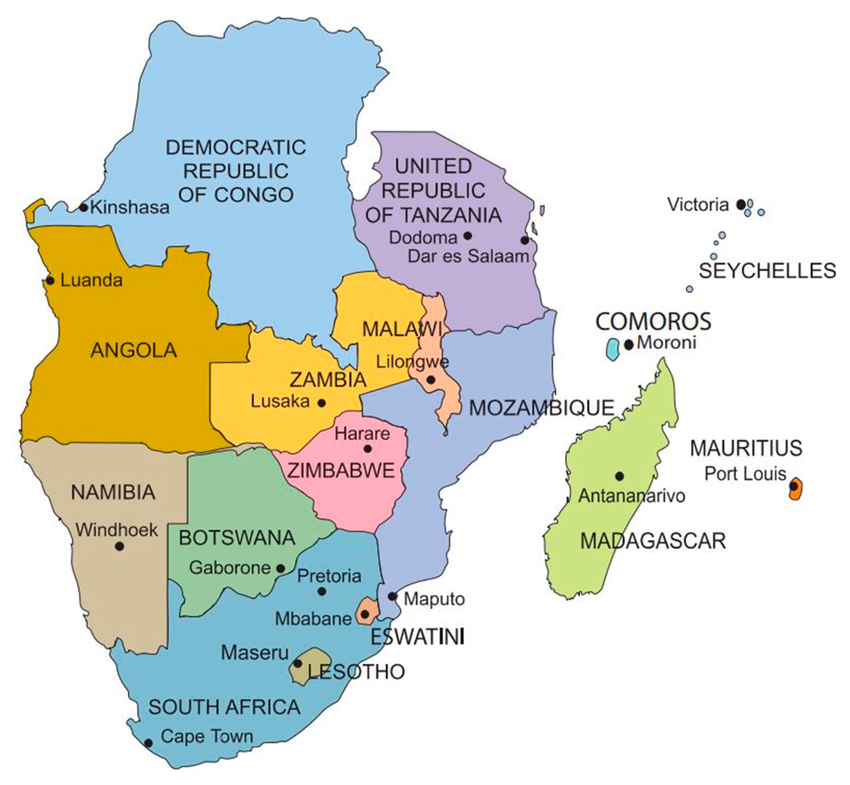
The transformation of the organisation from a Coordinating Conference into a Development Community (SADC) took place on August 17, 1992, in Windhoek, Namibia when the Declaration and Treaty was signed at the Summit of Heads of State and Government thereby giving the organisation a legal character.
SADC headquarters are in Gaborone, Botswana.
SADC Parliamentary Forum
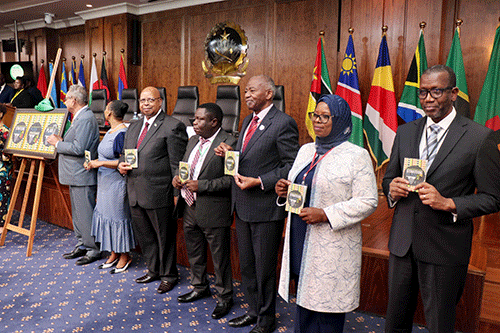
The Southern African Development Community Parliamentary Forum (SADC PF) was established in 1997 in accordance with Article 9 of the SADC Treaty as an autonomous institution of SADC It is a regional inter-parliamentary body composed of fifteen (15) parliaments representing over 3500 parliamentarians in the SADC region.
Since 2024 the SADC Parliamentary Forum currently comprises of 16 Member parliaments:
- Angola
- Botswana
- Lesotho
- Madagascar
- Malawi
- Mauritius
- Moçambique
- Namibia
- Republic of South Africa
- République démocratique du Congo
- Seychelles
- Swaziland
- Union of Comoros
- United Republic of Tanzania
- Zambia
- Zimbabwe
AIMS
The Forum seeks to bring regional experiences to bear at the national level, to promote best practices in the role of parliaments in regional cooperation and integration as outlined in the SADC Treaty and the Forum Constitution. Its main aim is to provide a platform for parliaments and parliamentarians to promote and improve regional integration in the SADC region, through parliamentary involvement.
OBJECTIVES
The Southern African Council of Non-Governmental Organisations (SAf-CNGO), formerly the Southern African Development Community of Non-Governmental Organisations (SADC-CNGO), is a regional umbrella body of national associations of NGOs operating in all the 16 Member States of the Southern Africa Development Community (SADC).
SAf-CNGO was formed in 1998 in Gaborone, Botswana with the aim of facilitating effective and meaningful engagement between civil society in the region and SADC institutions at both national and regional levels.
The Southern African Council of Non-Governmental Organisations (SAf-CNGO), formerly the Southern African Development Community of Non-Governmental Organisations (SADC-CNGO), is a regional umbrella body of national associations of NGOs operating in all the 16 Member States of the Southern Africa Development Community (SADC).
SAf-CNGO was formed in 1998 in Gaborone, Botswana with the aim of facilitating effective and meaningful engagement between civil society in the region and SADC institutions at both national and regional levels.
The SAf-CNGO participated in several SADC processes including the development of a SADC mechanism for engagement with Non-State Actors, and the development of SADC Vision 2050, drafting of the SADC Regional Poverty Reduction Framework, as well as in designing the SADC Regional Poverty Observatory mechanism.
The Non-State Actors Engagement Mechanism is one of the key mechanisms to close the existing gaps in the engagement between the Non-State Actors and SADC at both regional and national levels.
Regional civil society structures can facilitate ‘positive partnership’ between the SADC citizens and governments in the region. For this to be achieved, civil society and governments need to harness each other’s positive attributes and shun negative engagements.
In August 2019, the SADC Business Council was launched; SADC re-affirmed the importance of the two mechanisms on SADC’s engagement with civil society on one hand, and with business on the other, and that they need to be synchronised in the future.
One of the key functions of the SADC Business Council was to streamline the role of the private sector in the technological and economic transformation of SADC Member States through industrialisation.
SAf-CNGO is based in Gaborone, Botswana.

The Pan-African Parliament (PAP) was set up to ensure the full participation of African peoples in the economic development and integration of the continent.
The PAP is intended as a platform for people from all African states to be involved in discussions and decision making on the problems and challenges facing the continent. The Parliament sits in Midrand, South Africa.
Rather than being elected directly by the people, PAP members are designated by the legislatures of their Member State and members of their domestic legislatures. The ultimate aim is for the Parliament to be an institution with full legislative powers, whose members are elected by universal suffrage. Until such time, the PAP has consultative, advisory and budgetary oversight powers within the AU.
The Pan-African Parliament is situated in Midrand, South Africa.
The Committees are:
- Committee on Education, Culture, Tourism and Human Resources
- Committee on Cooperation, International Relations and Conflict Resolution
- Committee on Gender, Family, Youth and People with Disabilities
- Committee on Monetary and Financial Affairs
- Committee on Trade, Customs and Immigration Matters
- Committee on Health, Labour and Social Affairs
- Committee on Transport, Industry, Communications, Energy, Science and Technology
- Committee on Rules, Privileges and Discipline
- Committee on Justice and Human Rights
- Committee on Rural Economy, Agriculture, Natural Resources and Environment
- Committee on Audit and Public Accounts (CAPA)
The objectives and functions of the Parliament are set out in the Protocol to the Abuja Treaty relating to the Pan-African Parliament and in its Rules of Procedure.
- Facilitating and overseeing implementation of AU policies, objectives and programmes
- Promoting human rights and consolidating democratic institutions and culture, good governance transparency and the rule of law by all AU organs, Regional Economic Communities (RECs) and Member States
- Participating in creating awareness among the peoples of Africa on the: AU’s objectives, policy aims and programmes; strengthening of continental solidarity, cooperation and development; promotion of peace, security and stability; and pursuit of a common economic recovery strategy.
- Contributing to the harmonisation and coordination of Member States’ legislation
- Promoting the coordination of the RECs’ policies, measures, programmes and activities
- Preparing and adopting its budget and Rules of Procedure
- Electing its Bureau members
- Making recommendations on the AU budget
The Parliament is composed of five members per Member State that has ratified the Protocol establishing it, including at least one woman per Member State and reflecting the diversity of political opinions in their own national parliament or deliberative organ.1 Under rule 7(2) of the PAP Rules of Procedure, a parliamentarian’s tenure of office shall begin when he or she has taken the oath of office or made a solemn declaration during a PAP plenary session. A parliamentarian’s term should correspond to his or her own national parliament term or any other deliberative organ that elected or designated the parliamentarian.
The full Assembly of the Parliament is called the Plenary. It is the main decision-making body and passes resolutions. The Plenary consists of the Member State representatives and is chaired by the President of the Parliament.
The PAP organs are the Bureau and Permanent Committees.
- The Bureau is composed of a president and four vice-presidents, representing the five AU regions, and is responsible for the management and administration of the Parliament and its organs.
- There are 10 Permanent Committees and 1 ad hoc one, whose mandate and functions are set out in the PAP Rules of Procedure. These functions correspond to those of the AU Specialised Technical Committees. Each committee can have up to 30 members.
The PAP Rules of Procedure provide for each of the five geographic regions to form a regional caucus composed of its members. and for other types of caucuses to be established to deal with issues of common interest as the PAP deems necessary. There are two such caucuses: Women and Youth. Each caucus has a bureau comprising a chairperson, deputy chairperson and rapporteur.
The PAP Secretariat assists in the day-to-day running of the Parliament, including reporting meetings, organising elections and managing staff. The Secretariat consists of a clerk, two deputy clerks and support staff.
The PAP should meet at least twice in ordinary session within a one-year period. Parliamentary sessions can last for up to one month. The PAP can also meet in extraordinary sessions.
The Permanent Committees meet twice a year (March and August) for statutory meetings and can meet more often during parliamentary sessions or for non-statutory meetings when the need arises.
The caucuses meet in ordinary session twice a year during parliamentary sessions (Rules of Procedure, rule 28).
The PAP Permanent Committees
- Committee on Education, Culture, Tourism and Human Resources: It assists the Parliament with policy development and implementation of programmes on issues of access to education, promotion of culture and tourism, and human resource development.
- Committee on Cooperation, International Relations and Conflict Resolution: The Committee considers policy issues on international cooperation and international relations on behalf of the Parliament and AU. It also deals with conventions and protocols linking the Parliament with regional and international institutions. The Committee examines revisions of AU protocols and treaties and provides assistance to the Parliament in its conflict prevention and resolution efforts.
- Committee on Gender, Family, Youth and People with Disabilities: Considers issues relating to the promotion of gender equality and assists the Parliament to oversee the development of AU policies and activities relating to family, youth and people with disabilities.
- Committee on Monetary and Financial Affairs: Examines the Parliamentary budget draft estimates. It also examines the AU budget and makes recommendations. The Committee reports to the Parliament on any problems involved in the implementation of the annual AU and PAP budgets. It advises the Parliament on economic, monetary and investment policies.
- Committee on Trade, Customs and Immigration Matters: Deals with matters relating to the development of policy for cross-border, regional and continental concerns within the areas of trade (primarily external trade), customs and immigration. It assists the Parliament to oversee relevant organs or institutions and AU policies relating to trade.
- Committee on Health, Labour and Social Affairs: Works to support the implementation of social development, labour and health policies and programmes throughout the AU, including through regional and international cooperation strategies.
- Committee on Transport, Industry, Communications, Energy, Science and Technology: Assists the Parliament to oversee the development and implementation of AU policies relating to transport, communication, energy, science and technology, and industry.
- Committee on Rules, Privileges and Discipline: Assists the Parliament Bureau to interpret and apply the PAP Rules of Procedure, as well as matters relating to privileges and discipline. It considers requests for ‘waivers of immunity’ submitted under the Rules of Procedure and examines cases of indiscipline. The Committee also considers proposals for amending the Rules of Procedure.
- Committee on Justice and Human Rights: Assists the Parliament in its role of harmonising and coordinating Member States’ laws. It advocates for respect within the AU of the principles of freedom, civil liberties, justice, human and peoples’ rights, and fundamental rights.
- Committee on Rural Economy, Agriculture, Natural Resources and Environment: Considers the development of common regional and continental policies in the agricultural sector. It provides assistance to the Parliament to oversee and promote the harmonisation of policies for rural and agricultural development as well as the AU’s natural resources and environmental policies.
Committee on Audit and Public Accounts (CAPA): Considers internal and external audit reports on the PAP, and the Board of External Auditors’ reports on the AU and recommends measures for effective implementation of the recommendations.